Understanding How VPNs Facilitate Anonymous Browsing
Virtual Private Networks (VPNs) have become essential tools for users who want to reduce the visibility of their online activity and limit how much identifiable information is exposed during browsing. In a typical internet connection, data travels through multiple intermediaries, including internet service providers (ISPs), network operators, and websites themselves. Each of these points can potentially observe or log aspects of user behavior. A VPN changes this dynamic by introducing an intermediary layer that prioritizes privacy, data protection, and controlled exposure.
At a basic level, a VPN routes your internet traffic through a remote server operated by the VPN provider. This process separates your identity from your browsing activity in a way that complicates direct tracking. While it does not guarantee complete anonymity, it significantly reduces the ease with which entities can link actions to a specific individual or location.
Encryption: The Core of VPN Functionality
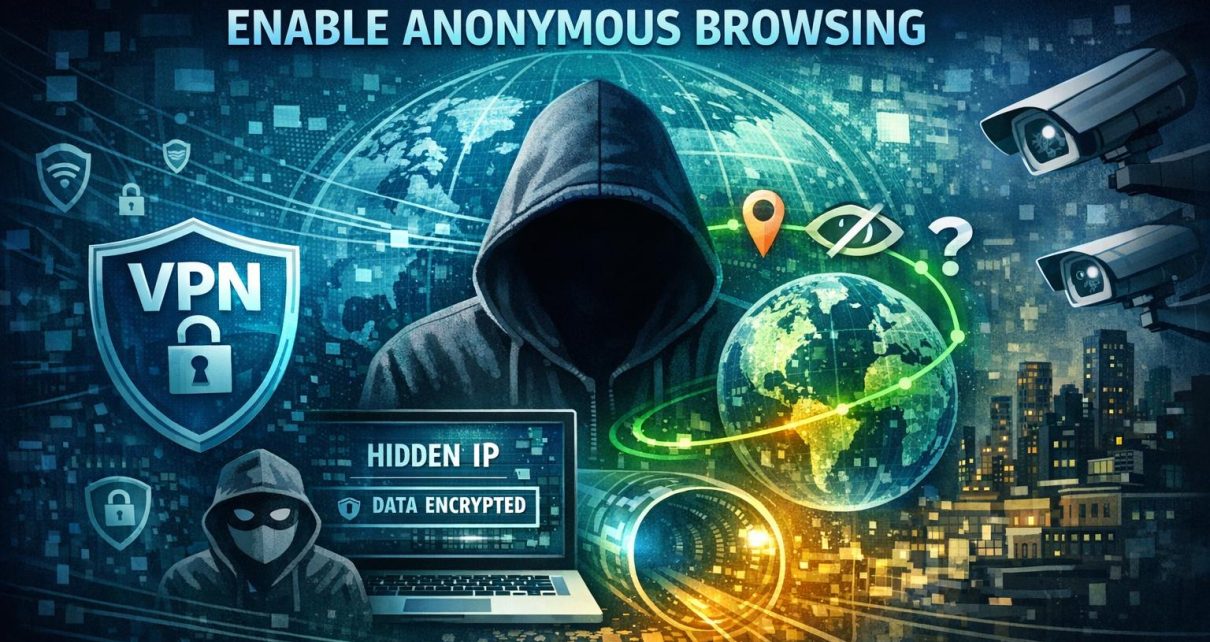
The foundational element of any VPN service is its use of encryption to secure data in transit. When a VPN connection is established, it forms a secure tunnel between the user’s device and the VPN server. All data passing through this tunnel is encrypted before leaving the device and decrypted only when it reaches the VPN server.
This encryption ensures that even if data packets are intercepted during transmission, their contents remain unreadable without the appropriate decryption keys. VPN providers typically rely on well-established protocols such as OpenVPN, WireGuard, IKEv2/IPSec, and L2TP/IPSec. Each protocol balances speed, security, and reliability differently, but all aim to prevent unauthorized access to transmitted data.
Encryption is particularly important when using unsecured networks, such as public Wi-Fi in cafes, airports, or hotels. In such environments, attackers may attempt to intercept traffic through techniques like packet sniffing or man-in-the-middle attacks. A properly configured VPN mitigates this risk by ensuring that intercepted data remains unintelligible. This capability is one of the main reasons VPNs are widely used in both personal and professional contexts.
IP Address Masking
Another essential feature of VPNs is their ability to mask your IP address. An IP address functions as a unique identifier assigned to each device connected to the internet. It can reveal general information about a user’s geographic location and network provider. Websites, advertisers, and tracking systems commonly use IP addresses to build user profiles and monitor behavior across sessions.
When connecting through a VPN, your original IP address is replaced with the IP address of the VPN server. As a result, websites and online services see the server’s location instead of your actual one. This process does not make tracking impossible, but it does make it more complex and less precise.
IP masking also helps reduce the effectiveness of location-based targeting systems. For example, advertising networks that rely on geographic data may deliver less accurate profiles. It also limits exposure to certain types of network-level surveillance, as ISPs can no longer easily determine which websites a user is accessing, even though they may still see that a VPN is in use.
Bypassing Geo-Restrictions and Censorship
VPNs are frequently used to bypass geographic restrictions and navigate around internet censorship systems. Many online services restrict access to content based on the user’s location, often due to licensing agreements or regulatory requirements. By connecting to a VPN server in a different country, users can appear as though they are browsing from that region.
This capability extends to environments where internet access is restricted or filtered. In regions with strict controls over online content, VPNs can provide a means to access blocked websites and services. By routing traffic through external servers, users can avoid local filtering mechanisms and access a broader range of information.
However, the effectiveness of this function depends on both the VPN provider and the restrictions in place. Some services actively block known VPN servers, while certain governments deploy advanced detection techniques to limit VPN usage. As a result, users may encounter inconsistent performance or need to switch servers to maintain access.
Additional Privacy Layers and Traffic Handling
Beyond encryption and IP masking, many VPN providers incorporate supplementary features to enhance privacy. These include DNS leak protection, which ensures that domain name queries are also routed through the encrypted tunnel rather than exposed to the ISP. Another common feature is a kill switch, which automatically disconnects internet access if the VPN connection drops, preventing accidental exposure of real IP addresses.
Some VPNs also offer multi-hop configurations, where traffic is routed through multiple servers in sequence. This adds another layer of abstraction, making correlation attacks more difficult. While these features can strengthen privacy, they often introduce additional latency, affecting browsing speed and performance.
It is also important to understand how VPN providers handle user data internally. Even though a VPN hides activity from external observers, the provider itself may have the ability to log connection details. Policies vary widely, and terms such as no-logs can differ in implementation. Reviewing provider documentation and independent assessments can help clarify how data is managed.
Considerations and Potential Pitfalls
Despite their advantages, VPNs are not comprehensive solutions for anonymity. They address specific aspects of online privacy but do not eliminate all tracking mechanisms. For instance, websites can still use cookies, browser fingerprinting, and account-based tracking to identify users across sessions. Logging into personal accounts while using a VPN may also negate some of its anonymity benefits.
The choice of VPN provider is a critical factor. Some free services may offset operational costs by collecting user data or displaying advertisements. Others may lack robust security measures, increasing the risk of data leakage. Selecting a provider with transparent policies and a demonstrated commitment to privacy is essential for maintaining the intended level of protection.
Performance is another consideration. Because VPNs route traffic through additional servers and apply encryption, they can introduce latency and reduce connection speed. The extent of this impact depends on factors such as server distance, network congestion, and protocol efficiency.
Ultimately, VPNs are most effective when used as part of a broader approach to online privacy. Combining them with secure browsing habits, privacy-focused applications, and awareness of tracking methods leads to more consistent protection. While they do not provide absolute anonymity, they represent a practical and widely accessible tool for reducing exposure and controlling how online activity is observed.