Understanding Proxy Servers and VPNs
In today’s digital environment, online interactions generate continuous data exchanges between users, websites, and network intermediaries. Protecting this data has become a practical concern for individuals and organizations. Two commonly used tools for managing exposure and controlling access are proxy servers and VPNs (Virtual Private Networks). Although both technologies can obscure a user’s IP address and alter how network requests are routed, they differ significantly in structure, scope, and level of protection.
Proxy Servers: An Overview
A proxy server functions as a gateway between a user and the internet. Instead of sending requests directly to a website or service, the user’s device communicates with the proxy, which then forwards the request on their behalf. The response from the destination server is returned to the proxy and then relayed back to the user.
This process changes the apparent origin of the request. Websites and online services will see the IP address of the proxy server rather than the user’s actual IP. As a result, the proxy provides a level of identity masking, which can be useful in various contexts such as content access and basic anonymity.
There are different types of proxy servers, including HTTP proxies, HTTPS proxies, and SOCKS proxies. Each type handles traffic differently. For example, HTTP proxies are designed specifically for web traffic, while SOCKS proxies operate at a lower level and can handle a wider range of protocols. The choice of proxy type determines compatibility with applications and the level of flexibility available.
Use Cases for Proxy Servers
Proxy servers are frequently used in situations where modifying or controlling network access is more important than securing data. One common use is accessing region-restricted content. By selecting a proxy server located in a different geographic region, users can appear to be browsing from that location.
Organizations also use proxy servers for traffic filtering and monitoring. In corporate or institutional networks, proxies can restrict access to certain websites, log user activity, or enforce usage policies. In these cases, the proxy acts as both a control mechanism and a monitoring tool.
Another practical application is reducing bandwidth usage through caching. Some proxy servers store copies of frequently accessed content. When multiple users request the same resource, the proxy can serve the cached version instead of retrieving it repeatedly from the internet, improving efficiency.
Limitations of Proxy Servers
Despite their usefulness, proxy servers have several important limitations. A key constraint is that they typically operate at the application level. This means that only software specifically configured to use the proxy will benefit from it. Other applications on the device will continue to connect directly to the internet, exposing the user’s real IP address.
Additionally, most standard proxy servers do not provide encryption. Data transmitted through a proxy can often be intercepted or inspected if it travels over unencrypted channels. This limitation makes proxies unsuitable for transmitting sensitive information, such as login credentials or financial data, unless combined with other security measures.
Reliability is another consideration. Public or free proxy servers may be unstable, slow, or overloaded. In some cases, they may also log user activity, which reduces the privacy benefits they are intended to provide.
Virtual Private Networks (VPNs): An Overview
A VPN is designed to address many of the shortcomings associated with proxy servers by providing a more comprehensive approach to privacy and security. When a VPN is activated, it establishes an encrypted tunnel between the user’s device and a remote server operated by the VPN provider. All network traffic is routed through this secure tunnel.
This approach ensures that data transmitted between the user and the VPN server is protected from interception. It also replaces the user’s IP address with that of the VPN server, similar to how a proxy functions, but with broader coverage and stronger safeguards.
VPNs operate at the system level rather than the application level. Once connected, all internet-enabled applications on the device automatically use the VPN connection unless specifically configured otherwise. This makes VPNs more consistent in their protection compared to proxies.
Benefits of Using a VPN
One of the primary advantages of a VPN is its ability to provide end-to-end encryption for network traffic. This is particularly relevant when using public or untrusted networks, such as those found in airports or cafes. Encryption prevents third parties from easily accessing or modifying transmitted data.
VPNs also offer comprehensive traffic management. Because all data passes through the VPN tunnel, applications do not need individual configuration. This simplifies usage and reduces the risk of accidental exposure caused by misconfigured software.
Another benefit is consistency in masking identity. Since all outgoing traffic uses the VPN server’s IP address, there are fewer gaps in coverage compared to proxy-based setups. This can support activities that require stable and continuous IP masking.
Limitations of VPNs
While VPNs offer broader protection, they are not without trade-offs. Encryption introduces computational overhead, which can result in slower connection speeds. The degree of slowdown depends on factors such as server distance, server load, and the encryption protocol used.
Trust in the VPN provider is also a factor. Because all traffic is routed through the provider’s infrastructure, the provider has the potential to log or monitor activity. Reputable services typically publish policies regarding data handling, but the level of transparency can vary.
Cost is another consideration. While some VPN services are offered without charge, free options may impose limitations such as bandwidth caps, reduced speeds, or data collection practices. Paid services generally provide more reliable performance and clearer privacy policies.
Key Differences
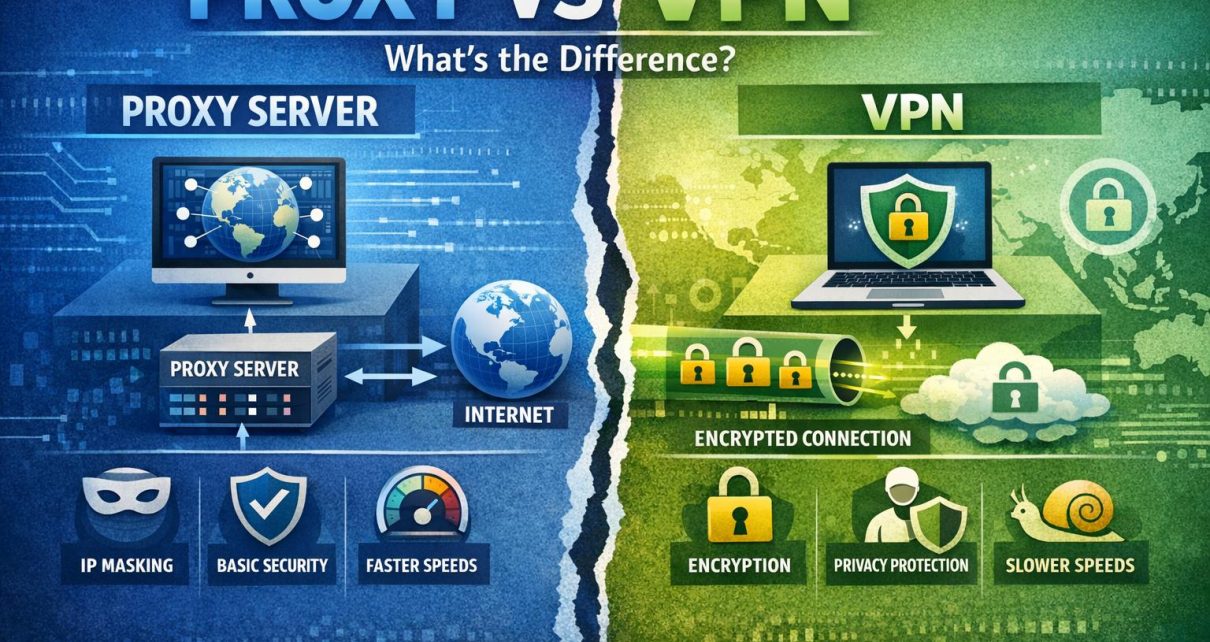
The distinction between proxy servers and VPNs can be understood by examining their scope and security features. Proxy servers primarily focus on rerouting traffic for specific applications and masking IP addresses without inherently securing the data being transmitted.
In contrast, VPNs operate at a broader level by encrypting all internet traffic and routing it through a secure channel. This creates a more uniform and protected network environment. While both tools can alter a user’s apparent location, only VPNs are designed to protect the integrity and confidentiality of transmitted data.
Another difference lies in deployment. Proxies are often configured within individual applications or browsers, while VPNs are typically installed at the operating system level, affecting the entire device. This difference influences both usability and effectiveness.
Practical Considerations
Choosing between a proxy server and a VPN depends on the intended use. For tasks that require minimal configuration and do not involve sensitive data, a proxy server may be sufficient. Examples include accessing publicly available content from different regions or conducting basic testing of location-based services.
For scenarios involving data security, such as remote work, financial transactions, or communication over untrusted networks, a VPN provides more appropriate protection. Its encryption and full-traffic coverage reduce exposure to interception and unauthorized monitoring.
It is also possible to use both technologies in combination in specialized environments, such as corporate networks, where layered controls are necessary. In such cases, proxies may handle filtering and logging, while VPNs provide secure remote access.
Conclusion
Proxy servers and VPNs serve related but distinct roles in managing online activity. A proxy server offers a straightforward method for redirecting traffic and masking IP addresses on a limited scale. A VPN extends this concept by adding encryption and system-wide coverage, resulting in a more secure and consistent solution.
The appropriate choice depends on whether the priority is convenience, access control, or data protection. Understanding how each technology operates allows users to select the tool that aligns with their specific requirements.